The Weight of Responsibility — Why This Fight Is Personal for Privately Owned American Businesses
There’s a version of the American business story that rarely gets told in Washington.
It’s not about quarterly earnings or shareholder calls. It’s about family. It’s about legacy. It’s about the quiet, relentless responsibility of building something that lasts—not just for the next 24 months, but for the next generation.
For Tim Haag, President & CEO of State Collection Service, Inc., that responsibility isn’t abstract. It’s deeply personal.
His company has been family-owned for over 75 years. When he talks about “protecting the business,” he’s not talking about margins—he’s talking about protecting the livelihoods of employees he considers extended family. While recent regulatory changes impact every health system’s bottom line, the impact on rural hospitals is dramatic. In short, he’s talking about making sure rural hospitals stay open while ensuring mid-to-large health systems can continue to provide quality care without cutting services. He’s talking about whether the systems that hold healthcare together will still function five or ten years from now.
And increasingly, he’s talking about Washington.
When Policy Becomes Personal
Tim didn’t set out to become a voice in politics. Like many privately owned business leaders, he assumed someone else would handle that. But over the last decade—especially as healthcare regulation intensified—he realized something uncomfortable: if people like him didn’t show up, decisions would still get made… just without them.
“People often wait for someone else to take action. I wanted to go and do that.”
What he found when he stepped into that world surprised him.
The long days. The exhaustion. The nonstop meetings from early morning to late at night. But also something else—something more human.
“Politicians are just like you and I… just different titles and roles.”
That realization changed everything.
The Disconnect That Keeps Him Up at Night
At the center of Tim’s concern is a growing disconnect between policy decisions and real-world consequences.
Take reimbursements and medical debt.
Over the past several years, policymakers have pushed to reduce or eliminate the role of credit reporting in medical collections. On paper, it sounds compassionate. In practice, Tim sees unintended consequences building fast.
If there are no consequences for nonpayment, behavior changes.
“Now you’re telling people there’s no consequence for not paying your medical bills. Furthermore, eliminating ACA subsidies, decreases in funding from CMS, and the dramatic increase in High Deductible Health Plans put more responsibility on patient payments. The combination of increasing costs, declining reimbursements, and growing medical debt jeopardizes the livelihood of health systems. How is this sustainable? “
He’s not alone in asking that question.
When accountability mechanisms disappear, the ripple effects don’t land on large health systems first. They land on smaller providers. Rural hospitals and independent physicians.
And those systems are already fragile. When rural hospitals close, the patients in that area have to travel further for care. On top of that, insurance may not cover due to out of network coverage.
The Rural Reality Few Are Talking About
One of the most urgent issues Tim raises is how policy disproportionately impacts rural healthcare. Large well-known health systems can withstand some of the change largely through their foundation and investments. Not all health systems have that luxury. Mid-size and Rural hospitals cannot.
Reduced reimbursements and shifting collection rules don’t just hurt margins—they threaten survival.
And when a rural hospital closes, the consequences are immediate and human:
- A 30-minute drive becomes two hours
- Emergency care becomes inaccessible
- Outcomes worsen
This isn’t theoretical. It’s life and death.
The Cost of Not Being in the Room
Tim’s time in Washington has reinforced one critical truth:
Policy is often shaped without enough input from the people living with its consequences.
Committees make decisions about healthcare without healthcare operators. Regulators draft rules without business operators at the table.
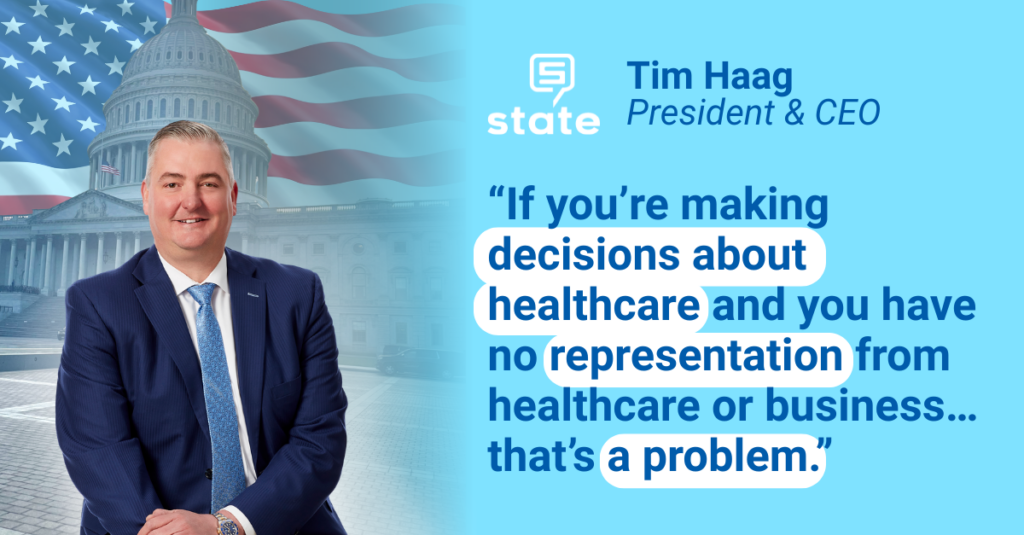
“If you’re making decisions about healthcare and you have no representation from healthcare or business… that’s a problem.”
So he’s made it his mission to fill that gap.
Not as a lobbyist in the traditional sense—but as a translator between two worlds that don’t understand each other nearly as well as they should.
A Different Approach to Influence
Tim’s philosophy is simple—and surprisingly uncommon in Washington:
“Everyone asks politicians for something. My attitude is: what can I do for you?”
That shift—from asking to offering—has helped him build real relationships across party lines.
Because at the end of the day, the most meaningful conversations don’t happen in formal hearings. They happen late at night. Over a beer. As people.
“People want to talk to us—we’re real people. Get to know each other as people, then we can talk business.”
The Bigger Mission: Protecting What Comes Next
For Tim, this work isn’t about politics. It’s about stewardship.
It’s about protecting a 77-year-old company built by his family—and ensuring it continues to support the families who depend on it.
It’s about pushing for policies that recognize reality, not just intention.
And it’s about making sure privately owned American companies—the ones without massive lobbying machines—still have a voice.
Because if they don’t? Someone else will speak for them.